Solutions for Insufficient Filling of Thin-Walled Parts in Plastic Molds
Thin-walled plastic mold parts refer to those with a regular wall thickness of no more than 1.5mm. Insufficient filling is a common defect in their injection molding, mainly caused by high melt flow resistance in the cavity that leads to rapid cooling and solidification before the cavity is fully filled. Unreasonable mold runner design and mismatched process parameters can worsen the problem. To solve this, follow the principle of first adjusting on-site processes, then optimizing mold structure, and finally adapting materials and equipment. Focus on three core aspects: reducing flow resistance, improving melt fluidity and preventing premature melt solidification. The solution should balance filling effect and part quality to avoid secondary defects such as flash and excessive internal stress.
1. Rapid On-Site Process Adjustment
Process adjustment is the first choice, requiring no mold modification and easy operation. All parameters must be adjusted gradually in small increments to avoid other defects caused by over-adjustment of a single parameter.
Increase melt and mold temperature: Raise the melt temperature by 5-15°C compared with regular parts, control PP melt temperature at 220-240°C and ABS at 230-250°C without exceeding the material thermal degradation temperature. Increase the mold temperature by 10-20°C, set the mold temperature of general plastics at 40-60°C and engineering plastics such as PC and PBT at 80-100°C, with precise temperature control by a mold temperature controller.
Boost injection pressure and speed: Raise the injection pressure by 10%-20%, the regular injection pressure is 80-120MPa and can be adjusted to 100-140MPa for thin-walled parts, not exceeding 80% of the rated equipment pressure. Increase the injection speed by 20%-30% compared with regular parts, control the speed of most thin-walled parts at 150-300mm/s. High-speed injection must match mold venting to prevent air trapping.
Optimize packing switchover and back pressure: Set the packing switchover position 5%-10% later than regular parts and control the back pressure at 3-5MPa to improve melt plasticization uniformity and compactness, avoiding melt overheating due to excessively high back pressure.
Adjust nozzle and runner temperature: Set the nozzle temperature 2-5°C slightly higher than the front section of the barrel. Ensure uniform temperature of the manifold and hot nozzles in hot runner molds with a temperature difference of no more than 2°C.
2. Mold Structure Optimization
If process adjustment is ineffective, conduct targeted mold structure optimization to fundamentally reduce flow resistance, focusing on four key parts: runners, gates, venting and cavities.
Optimize runner and gate design: Enlarge the main runner by 1-2mm and sub-runners by 0.5-1mm compared with regular designs. Prioritize side gates and fan gates, enlarge the gate width by 20%-30% and match the gate thickness to the part wall thickness. Adopt multi-point gates for complex thin-walled parts to ensure consistent runner length.
Strengthen the venting system: Add vent grooves at the cavity ends and weld lines with a depth of 0.01-0.02mm and a width of 8-15mm. Use vent inserts and vent pins in deep cavities and narrow gaps. Reserve a small vent gap between the nozzle and cavity in hot runner molds.
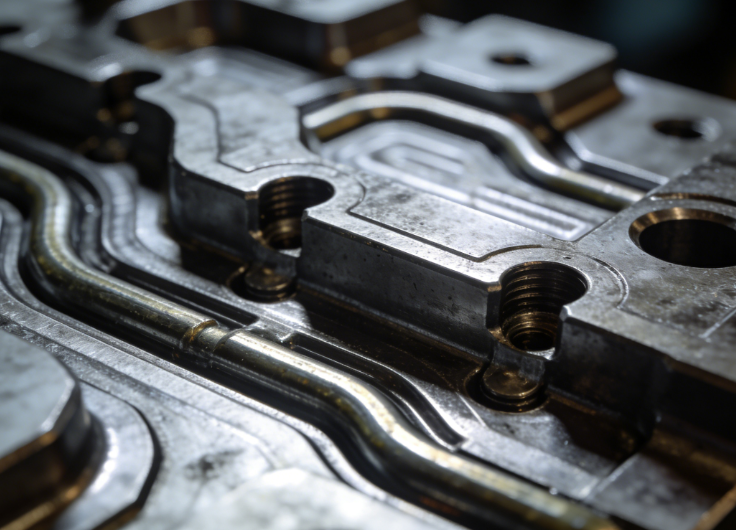
Improve cavity and cooling water channel design: Precision polish the cavity and runner surfaces to a roughness Ra of no more than 0.4μm. Control the distance between cooling water channels and cavity molding surfaces at 8-12mm, reduce water channel layout or add local heating devices in areas with rapid local cooling. Ensure the matching accuracy of mold guide pillars and ejector pins to avoid excessive mold clamping gaps.
Match mold accessories: Use high-polish, low-friction steel such as NAK80 and S136 for ejector pins and inserts. Ensure tight fit of the mold parting surface and install precise positioning devices to prevent mold clamping offset.
3. Molding Material Adaptation and Adjustment
Improve fluidity from the raw material side, balancing material fluidity and the basic mechanical properties of parts without affecting product performance.
Select high-fluidity grades: For general plastics, choose PP with a melt flow index (MFI) of no less than 30g/10min, PE no less than 25g/10min and ABS no less than 20g/10min. For engineering plastics, select PC with an MFI of no less than 15g/10min and PBT no less than 30g/10min.
Add flow modifiers: Mix 0.5%-2% of flow modifiers such as fatty acid esters and polyolefin waxes into the base material, and avoid excessive addition of fillers such as calcium carbonate and talcum powder.
Optimize the formula of glass fiber modified materials: Control the glass fiber content at 15%-20% and select short glass fibers of 3-5mm. Add coupling agents to improve the bonding between glass fibers and resin.
4. Injection Equipment Parameter Matching
The rapid and high-pressure filling of thin-walled parts has high requirements for the plasticization and injection capacity of equipment. Conduct targeted adjustment of equipment configuration and parameters to ensure stable transmission of pressure and speed.
Select suitable injection machines: Prioritize equipment with an injection speed of no less than 300mm/s and an injection pressure of no less than 160MPa. Servo-driven injection machines with higher control precision are more suitable for thin-walled part production.
Optimize the screw and plasticization system: Adopt a screw with a length-diameter ratio of 28:1-32:1. Set the screw compression ratio at 2.5:1-3:1 for general plastics and 3:1-3.5:1 for engineering plastics. Repair or replace worn screws and barrels in a timely manner.
Equip with auxiliary devices: Install an accumulator to improve the instantaneous injection speed and pressure. Use a hopper dryer to control the raw material moisture content—keep the moisture content of ABS and PC at no more than 0.05% to avoid melt viscosity increase caused by hydrolysis.
5. On-Site Operation Precautions
All parameter adjustments must be coordinated. High-speed injection must match high mold temperature and high-quality venting to avoid flash, air trapping and other problems caused by single adjustment.
After mold optimization, simulate the melt filling process through mold flow analysis to predict flow resistance and air trapping positions, and conduct advance optimization to reduce trial molding times.
Regularly check the raw material dryness and nozzle temperature during production, and timely clean the solidified material in runners and gates to prevent melt flow obstruction caused by blockage.
Properly reduce the packing pressure and time after filling thin-walled parts to reduce internal stress and prevent deformation and cracking after demolding.
Summary
The core of solving insufficient filling of thin-walled parts in plastic molds is to reduce resistance, improve fluidity and prevent premature solidification. In on-site production, priority is given to rapid improvement through adjusting process parameters such as temperature, pressure and speed, which is the lowest cost and most efficient method. If process adjustment is ineffective, optimize the mold runner, gate and venting system to fundamentally solve the flow resistance problem. Finally, achieve precise matching of melt fluidity and filling conditions through material grade selection and equipment parameter matching. In actual production, avoid single-dimensional optimization. Realize full cavity filling of thin-walled parts and balance the appearance and mechanical properties of parts through coordinated adjustment of mold, process, material and equipment, thus achieving stable mass production of thin-walled parts while eliminating secondary defects such as flash, internal stress and air trapping.