Methods for Determining Packing Switchover Position in Injection Molding
The packing switchover position is a core parameter in injection molding, marking the shift from injection to packing phase. It directly affects part filling, dimensional accuracy and surface quality—an early switch causes short shots, sink marks and material shortage, while a late switch leads to flash, excessive internal stress and deformation. There is no fixed value for it, and it should be determined based on part structure, material properties and gate design. The mainstream industry approach is mold flow analysis + trial molding adjustment, combined with empirical estimation for quick setup. Below are the refined practical methods, adjustment tips and problem solutions.
1. Core Determination Methods
(1) Step-by-Step Trial Molding Adjustment (Most Used)
Follow the industry standard: switch when the part is 95%-98% filled.
Set a late initial position (100% filling) and test inject at low speed/pressure to check for flash, recording the injection position.
Move the position forward in 0.5-2mm steps and test 3-5 shots each time until slight sink marks appear (the lower filling limit).
Move back 1-3mm from the limit for the optimal position, then fine-tune packing pressure and time for defect-free parts.
Verify with 20-30 consecutive shots to confirm no defects.
(2) Mold Flow Analysis Prediction (For New Molds)
Use software like Moldflow/Moldex3D to simulate melt filling, predict the 95%-98% filling position as the theoretical optimal switchover position, and make minor adjustments (±1-2mm) during trial molding based on actual equipment and raw material differences for mass production.
(3) Empirical Estimation (For Emergency Changeover)
Quickly estimate the initial position by experience:
By material fluidity: Late switch (98% filling) for high-fluidity materials (PP/PE/PS); early switch (95% filling) for medium/low-fluidity materials (PC/PMMA/glass fiber modified materials).
By part structure: Late switch for thick-walled parts (≥3mm) to reserve packing compensation space; early switch for thin-walled parts (≤1.5mm) to prevent flash; switch when the main cavity is filled but ribs are not for complex parts with dense ribs.
2. Fine Adjustment Tips
Gate type: Move pin gate positions forward 0.5-1mm for precise control; slightly move large gate positions backward to enhance packing effect.
Injection speed: Move forward 1-2mm for high-speed injection (to avoid false filling); set slightly late for low-speed injection (for uniform filling).
Plastic type: Late switch for crystalline plastics (PE/PA/POM, 1%-3% shrinkage) to compensate shrinkage; precise 95%-97% filling for amorphous plastics (ABS/PC/PVC, 0.4%-0.8% shrinkage) to prevent cracking.
Mold temperature: Slightly late switch for high mold temperature (slow melt cooling); early switch for low mold temperature (to avoid premature solidification).
3. Common Problems & Solutions
Sink marks, material shortage, obvious weld lines: Move position backward 0.5-2mm and increase packing pressure appropriately.
Flash, gate overflow, oversize parts: Move position forward 0.5-2mm and reduce packing pressure/time.
Surface bubbles, internal porosity: Move position forward, lower injection speed and improve mold venting.
Local sink marks: Keep the overall position unchanged and use stage packing for targeted compensation of thick-walled areas.
4. Key Operation Precautions
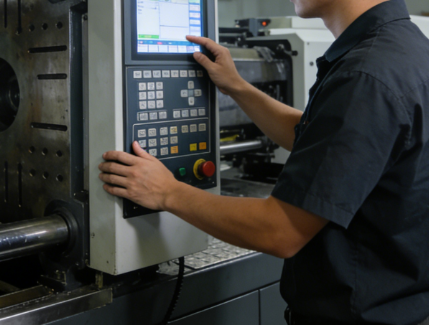
Align the position unit with the injection machine (mostly screw stroke, a few use injection volume).
Make a small ±0.5mm adjustment for the same part during changeover, considering raw material and equipment differences.
For precision parts (digital/medical components), combine mold flow analysis with trial molding, and record all parameters to form a standardized process card for stable mass production.
Summary
The core of setting the packing switchover position is to follow the 95%-98% filling rate and adjust based on actual production conditions. Use trial molding adjustment for on-site production, mold flow analysis for new molds, and empirical estimation for emergencies. Cooperate with the coordinated adjustment of packing pressure, time and injection speed to balance melt filling and packing compensation, eliminate common defects, and ensure stable part quality.